
Theseus vs. Ethereum
Ethereum contracts run when someone with a private key sends a transaction. Theseus agents run on their own.
Who initiates the action
Every Ethereum smart contract, no matter how complex, needs an externally owned account (EOA) to call it. The contract holds logic and state, but it cannot start work on its own. Services like Chainlink Keepers are off-chain bots with private keys that trigger contracts on a schedule; the contract itself is still reactive.
Theseus agents work differently. They run on a schedule, react to events, and initiate transactions themselves. Their authority comes from consensus over valid state transitions, not from a key holder pressing a button.
Vending machine vs. shopkeeper
Side-by-side
| Aspect | Ethereum contracts | Theseus agents |
|---|---|---|
| Key custody | Held by a human-controlled EOA | Held by the agent itself |
| Execution | Reactive, triggered by an EOA | Self-initiated on a schedule or event |
| Intelligence | Deterministic logic only | ML inference, verifiably |
| Logic | Conditionals, state machines | Same, plus model-driven reasoning |
| Inference | Not practical (replicated execution) | Native, with Tensor Commit proofs |
| Assets | Held; moved by external triggers | Held and moved by the agent |
Interaction flow
On Ethereum, every action passes through an EOA holding a private key. On Theseus, the agent itself is the actor.
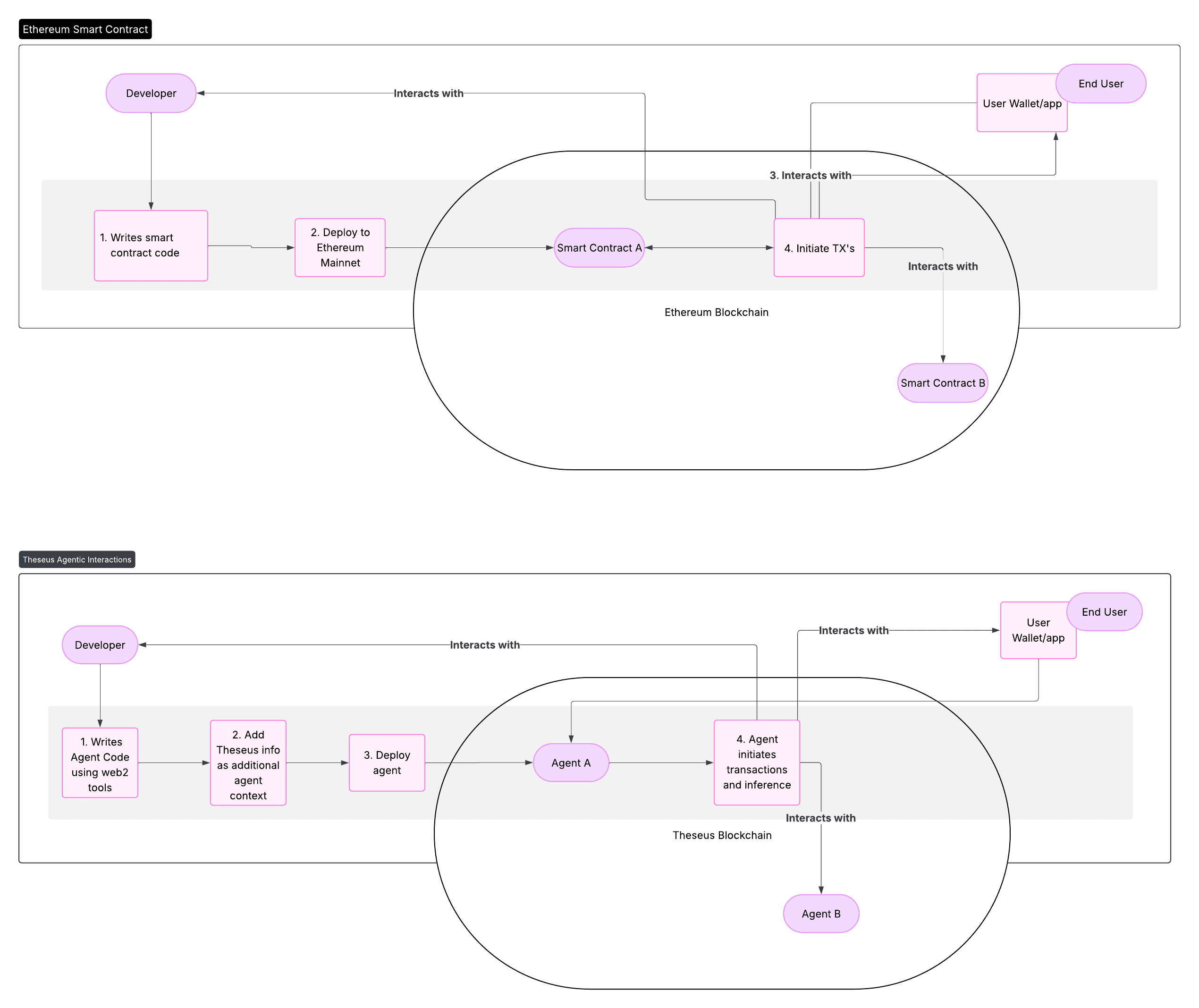
Top: Ethereum requires a developer with a private key to trigger every action.Bottom: Theseus agents initiate actions and run inference themselves.
Same deployment shape, different result
Smart contract
- 1. Write Solidity
- 2. Compile to EVM bytecode
- 3. Deploy (gas)
- 4. Contract waits for calls
- 5. An EOA must trigger anything
Theseus agent
- 1. Write the agent (Python, Rust, or SHIP)
- 2. Declare model bindings, policies, triggers
- 3. Deploy with an initial $THE balance
- 4. Agent starts operating
- 5. Acts on its own, no key holder
What this opens up
Self-initiated execution and verifiable inference make a class of applications practical that aren't today.
Ethereum supports
- • AMMs and lending
- • Token-voting DAOs
- • Objective oracles
- • Deterministic logic
Theseus adds
- • Subjective resolution (prediction markets, disputes)
- • Governance with reasoning, not just votes
- • Agents with goals and balance
- • Adaptive strategies driven by inference
A short lineage
Bitcoin (2009)
Public ownership. Removed treasurers from "who owns what."
Ethereum (2014)
Public programs. Removed judges from "what happens next."
Theseus (Now)
Public decisions. Removes hosts from "what will an intelligent entity decide?"
Three categories of agent
Theseus supports a spectrum from human-controlled to fully self-directed. The three categories on the homepage map to distinct application classes:
Public-good agents that read, reason, and sign their work. They don't hold funds; their job is to make outcomes cheap to verify (prediction-market resolvers, dispute arbitration, content provenance).
User-controlled agents that operate under signed policy. Humans, DAOs, or funds can pause, upgrade, or change strategy without losing the audit trail (treasuries, keepers, fund managers).
Self-directed agents that own their policy, balance, and history. They can outlast their founders, pay for their own inference, and earn fees directly.
Related reading
Theseus vs AI-infra peers
Side-by-side with Bittensor, Ritual, 0G, Modulus, Allora.
Agentic smart contracts
The thesis behind treating agents as the unit of on-chain logic.
AIVM
Tensor-native opcodes and the verifiable inference path that EVMs can’t express.
Execution model
Why agent calls run in three stages across blocks instead of one atomic transaction.