Agents & Smart Contracts 2.0
Smart contracts could act, but not think, interpret, and perceive. That single constraint shaped the entire history of crypto. Agents change the design space.
For most of the last decade, crypto has been described as a new financial system. The pitch was that finance, identity, governance, and most of the institutional plumbing of the modern world would migrate onto open networks where the rules were enforced by code instead of trust in people. What crypto actually built was an execution environment: software that could hold assets, enforce rules, and coordinate activity without relying on any institution in the middle. That turned out to be a very real breakthrough. It just wasn't enough on its own.
The problem was always that smart contracts could act, but not think, interpret, and perceive.
A smart contract can move money, settle a trade, or enforce collateral requirements with near-perfect reliability. But it cannot interpret context. It cannot read a document, evaluate intent, detect fraud, weigh ambiguity, or make a judgment call. The moment a system depended on interpretation rather than deterministic execution, the abstraction broke.
That constraint shaped almost the entire history of crypto.
The categories that worked over the last decade were the ones where the world could be reduced to explicit rules and clean inputs; stablecoins and decentralized exchanges. All other categories struggled because they depended on interpretation and judgment. Lending without overcollateralization. Insurance. Reputation. Governance. Prediction markets. Most forms of decentralized coordination. These systems all failed at the same boundary: somewhere in the loop, someone had to decide whether something was true.
Is this oracle being manipulated? Was this insurance claim legitimate? Is this computed result correct? Did this shipment actually arrive? Does this governance proposal make sense?
The contract itself could not answer those questions, so the decision leaked outward into committees, multisigs, moderators, legal entities, oracles, and informal governance structures. The trusted intermediary came back in a form worse than the institutions we already trusted. We spent ten years trying to build judgment-dependent systems on top of software that could not perform judgment.
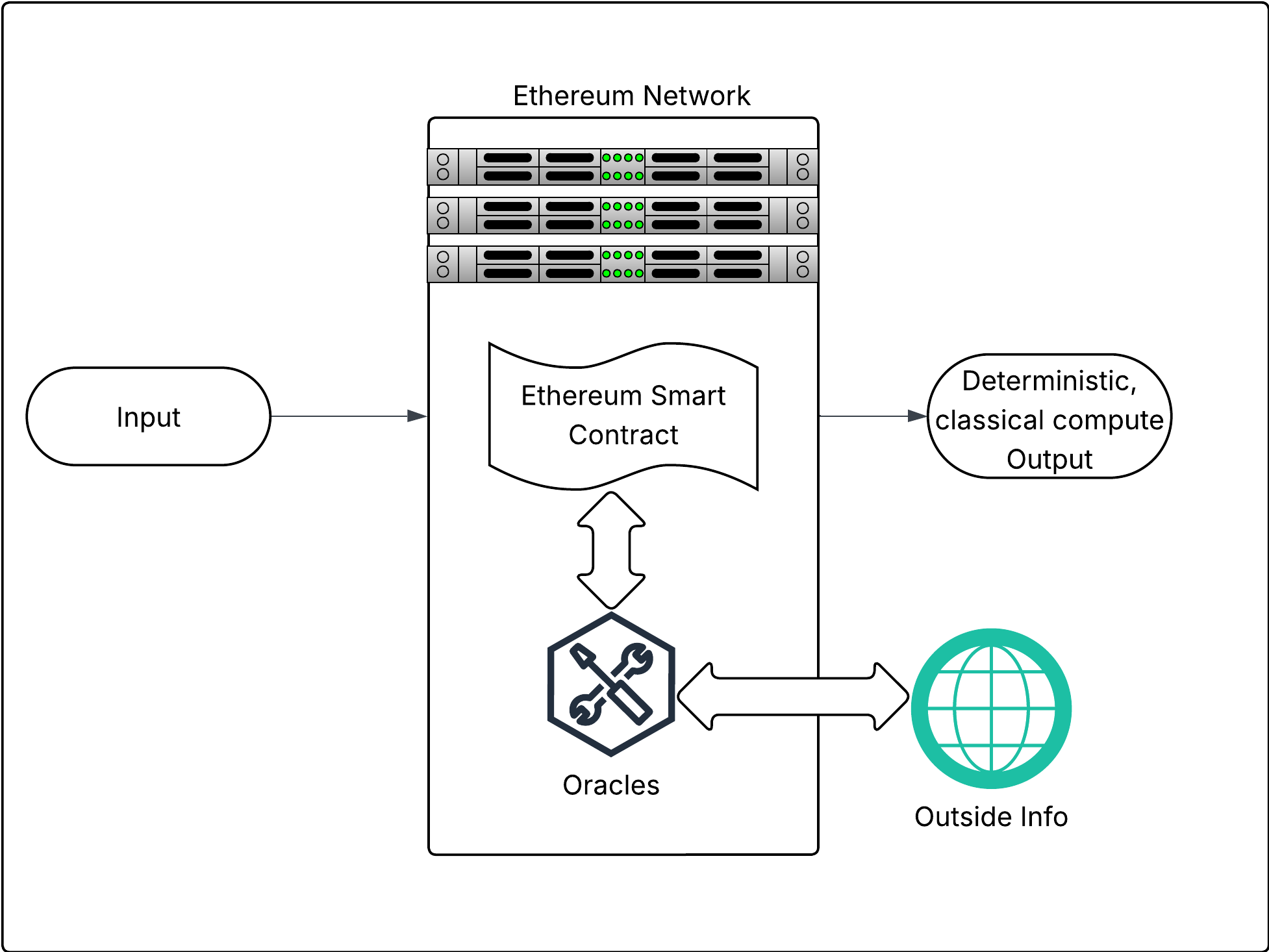
Ethereum smart contracts run a deterministic program against pre-supplied inputs. Oracles bring outside data in, but the contract itself cannot interpret it.
Agents change the design space
Not because AI models are perfect, but because machine intelligence and judgment now exists as a callable primitive. A model can interpret text, evaluate evidence, recognize patterns, detect inconsistencies, and produce a defensible decision inside a software system, and often surprisingly well. Once you combine machine judgment with programmable execution, the nature of the contract itself changes. A smart contract is no longer just a static rules engine. It becomes software capable of observing, reasoning, and acting.
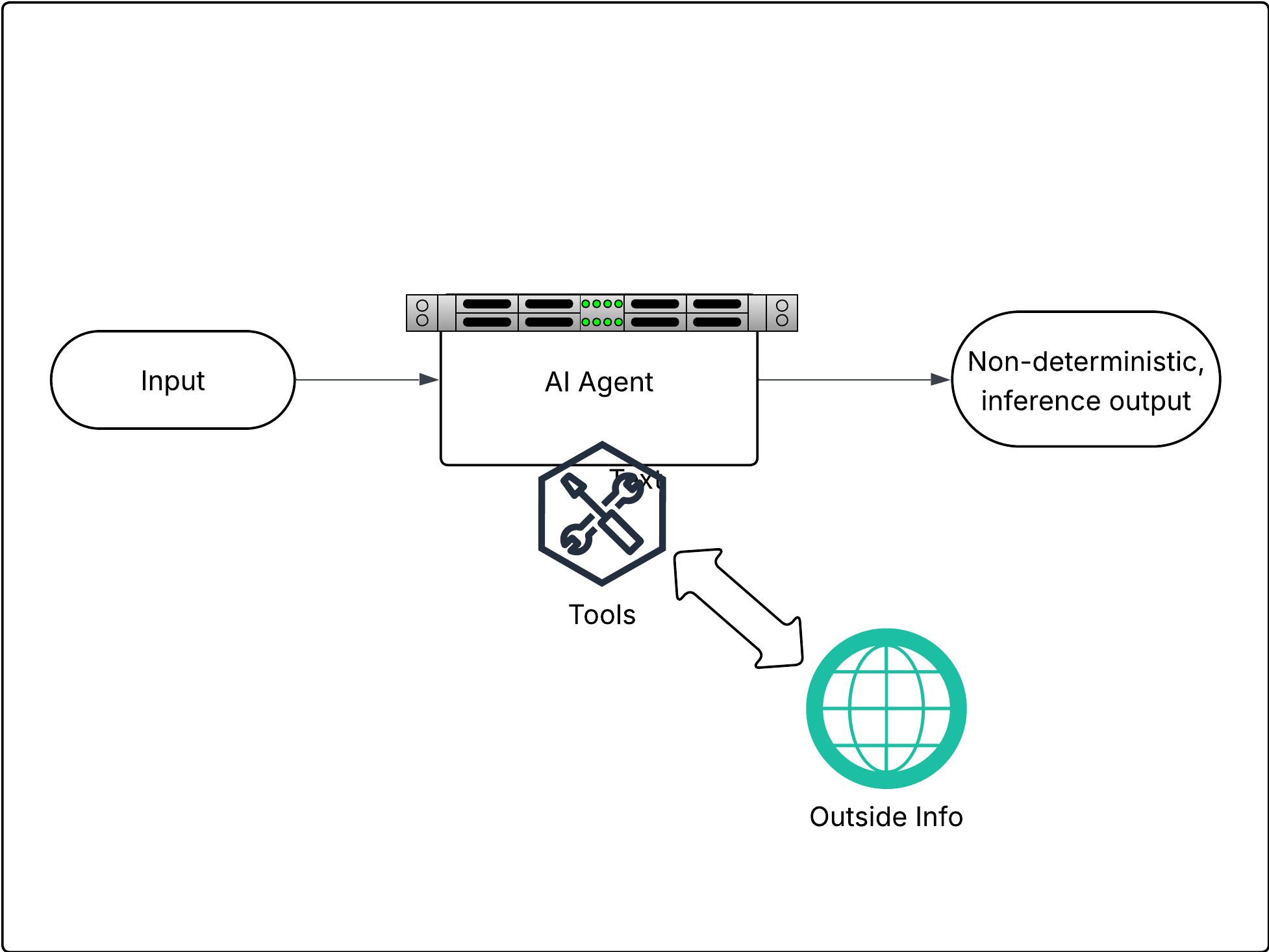
A web2 agent takes an input, calls tools, fetches outside information, and produces a non-deterministic, inference-based output. The judgment lives inside the agent.
The smart contract becomes an AI agent, and vice versa
This is why the recent wave of AI agents feels qualitatively different from the bots that came before. Most software historically could execute tasks but not interpret reality. Agents can now do both. They can read information, form judgments, take actions, and adapt over time. The original promise of smart contracts was about creating software-native institutions: systems that could coordinate economic activity without relying on centralized human operators. The problem was that institutions require judgment and perception, and blockchains up until now only knew how to execute rules.
Crypto suddenly looks different in that world
A market can monitor itself for manipulation. A lending protocol can evaluate risk instead of demanding blanket overcollateralization. An insurance system can adjudicate claims based on evidence rather than predefined triggers. A reputation system can emerge from observed behavior instead of static attestations. Governance can evolve from token-weighted polling into systems that can actually reason about outcomes and constraints. For years these ideas existed in an uncanny valley where they sounded plausible conceptually but collapsed operationally. The missing primitive was interpretation.
Now that interpretation layer exists
The new markets that traditional smart contracts promise to deliver, finally become possible. The categories that failed in the last decade become buildable. At the same time, a new class of economic participants is emerging that fits crypto rails naturally well.
Human beings have operated inside dense institutional layers for centuries. We have banks, courts, regulators, customer support, etc. Most people do not wake up desperate for a censorship-resistant settlement layer without intermediaries. But agents transacting, hiring each other, and settling their own disputes have no banks or courts to fall back on. They need an open economy.
For a decade the original vision felt almost real and never quite was. The rails existed. The assets existed. The settlement layer existed. But the execution model was still incomplete. Ethereum gave software the ability to hold assets and enforce rules.
Smart contracts 2.0 give software the ability to perceive, decide, and act.
That is not a marginal improvement to the chain. It is not faster blocks, cheaper gas, or a better VM. It is a shift from deterministic execution over pre-chewed inputs to cognitive execution over the world as it actually exists.
The world that was promised was waiting for smart contracts that could think.
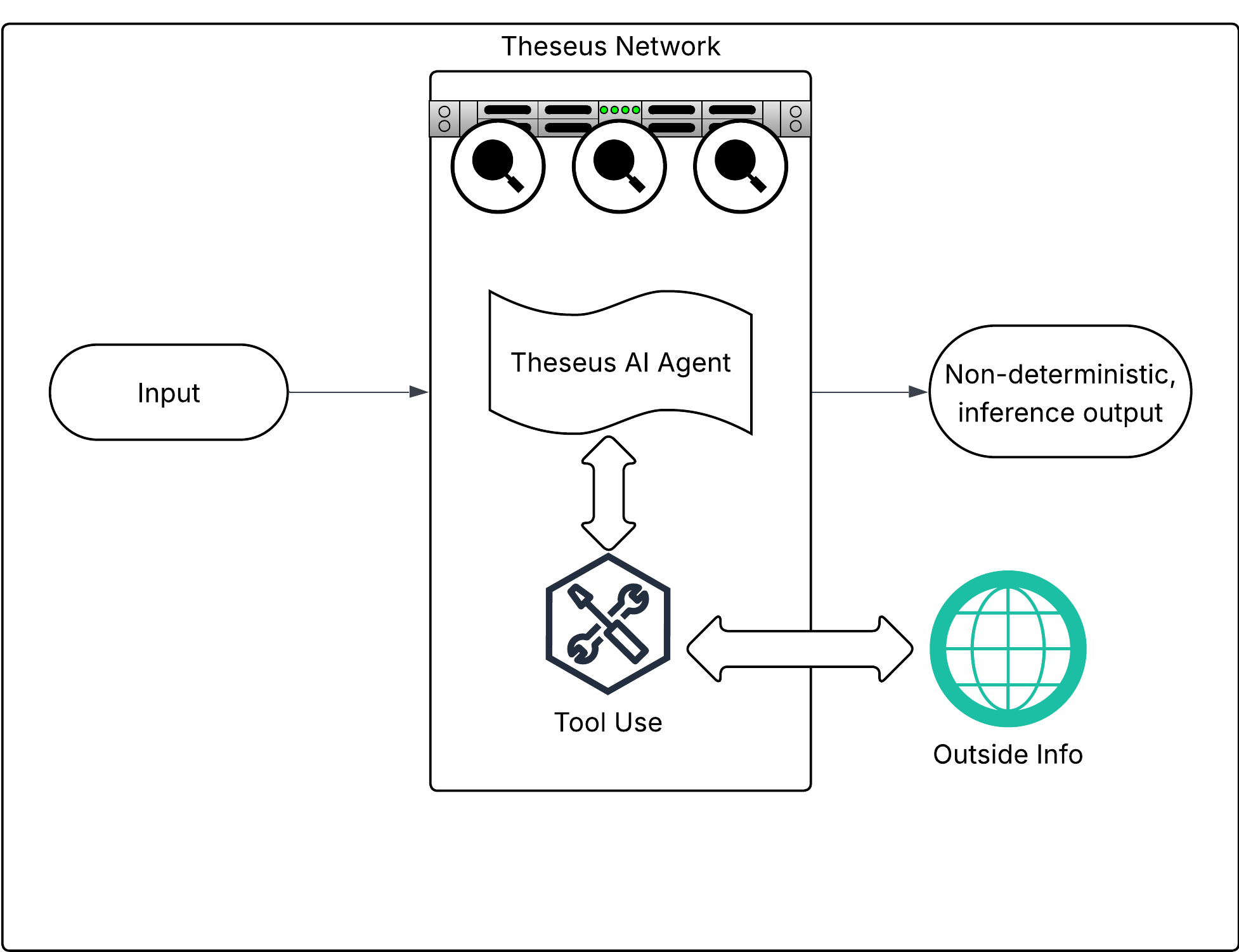
On Theseus, the agent shape is the same as a web2 agent, but it runs inside a network of replicated nodes that verify and persist what it did. Stateful, sovereign, signed.
Theseus gives agents the properties of smart contracts; persistent identity, verifiable execution, and independence. That means agents can hold resources, execute as themselves, prove what they did, and operate under rules multiple stakeholders can trust.